Home » Self-defense
Karate as self-defense
Karate as self-defense according to “the father of karate”: Gichin Funakoshi:
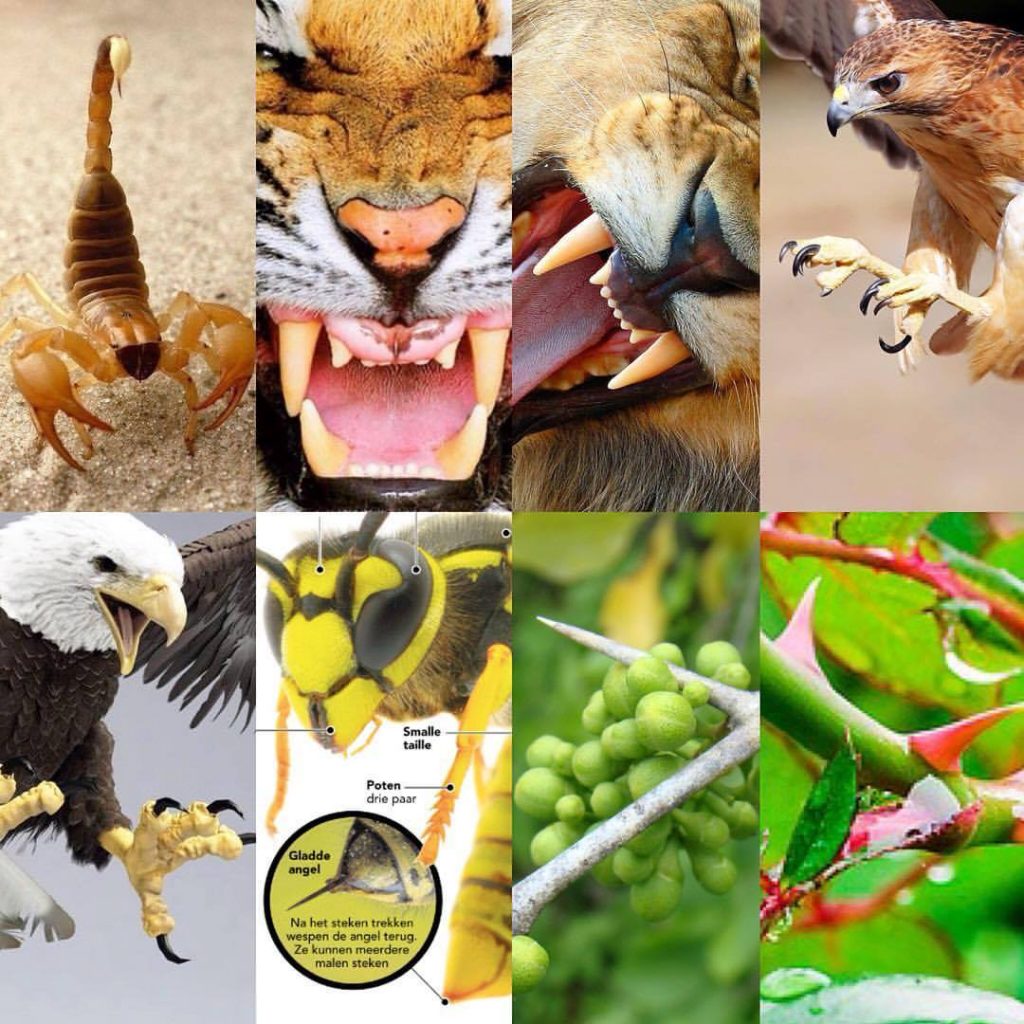
“Almost all living creatures have some mechanism for defending themselves, for, where this development is incomplete, the weaker are destroyed and perish in the fierce struggle for survival. The fangs of the tiger and lion, the talons of the eagle and hawk, the poisonous sting of the bees and scorpions, and the thorns of the rose and Bengal quince: are those not all preparations for defense? But if the lower mammals, birds, insects, and plants each have such specialization, should not man, the lord of creation, be prepared as well!
The basis for an appropriate answer to this question lies in the fact that, in principle, we have no intention of harming others. We prefer to steer clear of situations that could harm us. To protect oneself, one must find a method that will give the weak the power to defend themselves against stronger opponents. The power of karate has become well known in these times for its effectiveness in breaking boards or cracking stone without tools, and it is not an exaggeration to assert that a man well trained in this form of defense may consider the whole body tob e a weapon of awesomely effective offensive power. Source: Funakoshi, 1973, Karate-do Kyohan, The Master Tekst, Kodansha International, page 13. (Funakoshi’s first book was published in 1922).
Karate ni sente nashi ۞ 空手に先手なし ۞ Er There is no first strike in karate.
This is the second of the twenty principles that Funakoshi recorded in his book The Twenty Guiding Principles of Karate for future practitioners of karate.
Funakoshi: “A sword must never recklessly drawn” was the most important tenet of conduct in the daily life of a samurai. It was essential fort he honorable man of the day to bear things tot the very limitr of his ability before taking action. Only after reaching the point where the situation could no longer be tolerated was the blade drawn from its scabbard. This was a basic teaching of Japanese bushidō 武士道 (the Way of the Warrior).
Budō spirit
Even in an emergency one must strive to avoid striking a fatal blow. This may be likened tot he practice of hitting an attacker with the back ridge of a sword rather than with the cutting edge. It is crucial to allow an opponent time to reconsider or regret his actions.
It is only when faced with a situation so unbearable that one’s ability to tolerate it (or put an end to it without confrontation) is exhausted that the sword should be drawn fron its scabbard or the spear thrust at an opponent. This is the real spirit of budo. Nonetheless, in a worst-case scenario where combat is unavoidable, it is proper to take the initiative, attacking time and again until victory is achieved. Source: Funakoshi, The Twenty Guiding Principles of Karate, The spiritual legacy of the master, Kodansha International, 2003, page 23. (Original date of publication 1938).
Self-defense for women: if you're not strong(er) you must be smarter and practice regularly.
Funakoshi: The objective of martial arts has always been to defend oneself and not to attack others, and in the case of women’s self-defense this is especially true. If the physically delicate woman contests the attacks of a ruffian with physical force it is almost impossible for her to defend herself. Thus [as noted earlier], when attacked, it is possible to easily escape from danger through knowledge of self-defense; so by all means the fundamentals of self-defense should be ready for application at all times.
The comparative weakness of a woman in protecting herself from a more powerful opponent must be offset by her quick and especially accurate techniques in attacking the vital points. In order to achieve this, one must practice regularly; otherwise, during emergencies, one might hesitate or become excited and increase the danger instead of avoiding it. one should first practice forms and basic techniques and eventually work up to sparring practice as one becomes more skillful, imagining situations that women encounter most and constantly practicing them so that in a dangerous situation one may escape without harm.
Secret principles
Funakoshi: Rash methods often lead to serious injuries. There is a common saying: “A little learning is a dangerous thing.” Possessing even a small amount of knowledge about martial arts can quickly lead one to become reckless, resulting in harmful injuries with lasting consequences; therefore, one must always remember to exercise great caution. The secret principle of martial arts is not to defeat an attacker, but rather to make the decision to avoid a confrontation before it even takes place.
The secret principle of martial arts is not vanquishing the attacker but resolving to avoid an encounter before its occurrence. To become the object of an attack is an indication that there was an opening in one’s guard, and the important thing is to be on guard at all times. One should refrain from walking alone at night as much as possible, and when that is unavoidable, one should take a roundabout route to avoid dangerous neighborhoods.
If, even while taking precautionary measures, one should be attacked by hoodlums in a stroke of ill luck, then it is better to run away. Running away as far as possible and seeking shelter in someone’s home or shouting for help would bet he best forms of self-defense.
Self-protection
When there are no avenues of escape or one is caught even before any attempt to escape can be made, then for the first time the use of self-defense techniques should be considered. Even at times like these, do not show any intention of attacking, but first let the attacker become careless. At that time attack him, concentrating one’s whole strenght in one blow to a vital point, and in the moment of surprise, escape and seek shelter or help. It is most important to be on guard without becoming excited and to act with presence of mind throughout such a situation from the beginning and even once the situation is in hand.
When delivering the one blow against the attacker, the importance of using one’s whole strenght and being especially accurate cannot be overemphasized. In the event that this one blow is ineffective, the attacker will become more violent, a point not to be forgotten. The importance of using one’s whole strength and putting one’s heart and soul in this one attempt has been stressed, but it is also important to do so only after reaching a rational conclusion that there is no other way out. Source: Funakoshi, 1973, Karate-do Kyohan, The Master Tekst, Kodansha International, blz 233-234. (Original date of publication 1935).